
With ISEMBYLD, it’s possible to achieve
Motor function gains beyond SMN2-targeted treatment alone
Motor function gains beyond SMN2-targeted treatment alone1,2
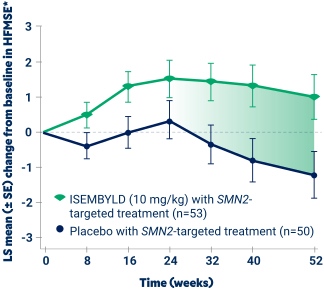
The efficacy of ISEMBYLD in people 2 years of age and older with SMA was demonstrated in a randomized, double-blind, multicenter, placebo-controlled clinical study called SAPPHIRE. The study included 188 people who were 2 to 21 years of age. All patients in the study were receiving an SMN2-targeted treatment and were non-ambulatory at baseline. The study measured motor function using scores from the Hammersmith Functional Motor Scale–Expanded (HFMSE).1 See the full study design
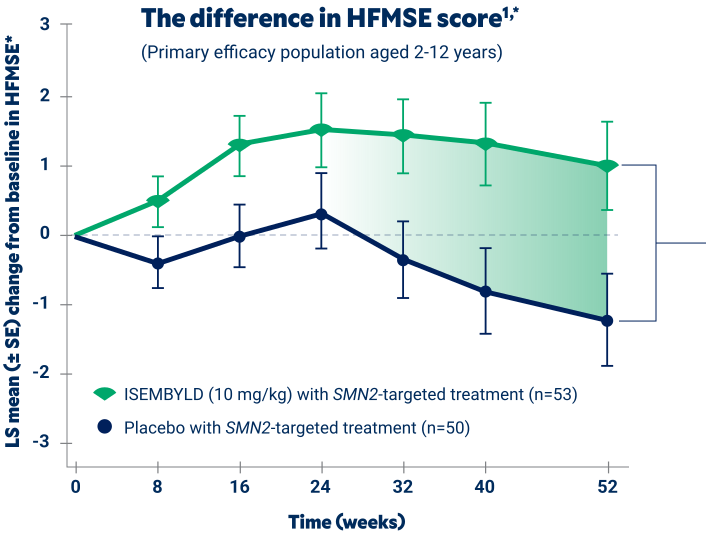
The difference in HFMSE score1,*
(Primary efficacy population aged 2-12 years)
2.2
point improvement at 52 weeks
P=0.0121 (nominal)
Observed benefit of ISEMBYLD with an SMN2-targeted treatment vs SMN2-targeted treatment alone increased over the study period with clinically meaningful improvement in motor function measured at 52 weeks1,2,*
*The primary efficacy analysis is based on the change from baseline to endpoint at 52 weeks. Results for all prior timepoints are descriptive only.
HFMSE=Hammersmith Functional Motor Scale-Expanded; LS=least squares; SE=standard error.
Treatment effect was consistent across predefined subgroups including adults and adolescents1,2,*,†
*The adult and adolescent subgroup was defined as individuals in the study aged 13-21 years.
†Improvements were numerical and do not imply significance.
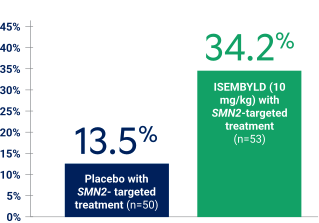
More than one-third of patients treated with ISEMBYLD observed a ≥3-point improvement in motor function2
Percentage of patients experiencing a ≥3 point
improvement in HFMSE total score* at 52 weeks2
(Population aged 2-12 years); P=0.0125 (nominal)*†
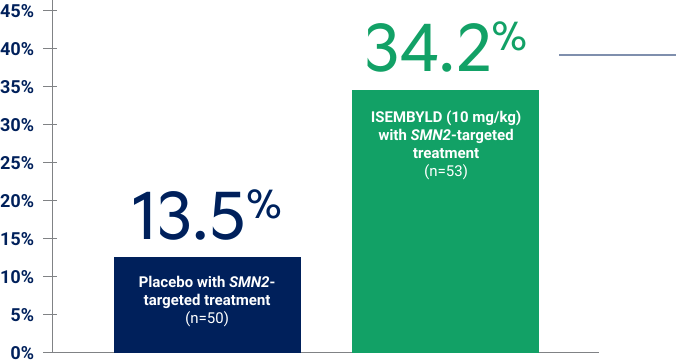
≥ 3
point increase in HFMSE
*Improvements were numerical and do not imply significance.
†Odds ratio of 3.8 (95% CI, 1.33-10.90). Logistic regression model covariates included baseline HFMSE total score and type of SMN2-targeted therapy. Missing HFMSE total scores were imputed.
CI=confidence interval; HFMSE=Hammersmith Functional Motor Scale–Expanded.
ISEMBYLD has been extensively studied1,3-5
Years of robust preclinical and clinical development involved both children and adults living with SMA1,3-5
Preclinical (2017)4
Purpose: Evaluate antibodies, including ISEMBYLD, designed to target myostatin, a negative regulator of muscle growth
PHASE 15
Purpose: Evaluate safety of single and multiple doses in healthy volunteers
STUDY POPULATION: N=66
Topaz PHASE 23
Purpose: Characterize efficacy and safety profile
STUDY POPULATION: N=58, AGED 2-21 YEARS
SAPPHIRE PHASE 3:

The pivotal study for ISEMBYLD1,2,*
A 52-week, randomized, multicenter, double-blind study.
Purpose: Placebo-controlled pivotal study to assess efficacy and safety.
STUDY POPULATION1,*
188
Children and adults with SMA continued their SMN2-targeted treatment and were randomized to receive either ISEMBYLD or placebo
2-21
years of age1
PRIMARY ENDPOINT1,*
HFMSE
Mean change from baseline at 52 weeks
RECOMMENDED DOSE1,2,‡
10 mg/kg
IV infusion once every 4 weeks
*All patients on SMN2-targeted treatment (either nusinersen or risdiplam) given per label.
†Primary efficacy population aged 2-12 years.
‡Recommended dose was tested in the primary efficacy population aged 2-12 (n=53).
HFMSE=Hammersmith Functional Motor Scale–Expanded; IV=intravenous; SMA=spinal muscular atrophy.
ACT NOW BEFORE MORE MOTOR FUNCTION IS LOST6
SAFETY
Safety & tolerability were observed as part of the pivotal study.1,2 View the safety profile.

RELATED FAQs

How was ISEMBYLD studied?
The efficacy of ISEMBYLD in people 2 years of age and older with SMA was demonstrated in a placebo-controlled clinical study called SAPPHIRE. The study included 188 people who were 2 to 21 years of age. All patients in the study were receiving an SMN2-targeted treatment and were non-ambulatory at baseline. The study measured motor function using scores from the Hammersmith Functional Motor Scale–Expanded (HFMSE), a tool specifically designed to evaluate motor function in SMA.1
What are the efficacy results for ISEMBYLD?
In the pivotal trial, muscle-targeted ISEMBYLD with an SMN2-targeted treatment provided a clinically meaningful improvement in motor function compared to an SMN2-treatment alone in patients with SMA aged 2 to 12. The difference in HFMSE score between groups increased throughout the study, with a 2.2-point mean gain at 52 weeks. The primary efficacy analysis was based on the change from baseline.1,2
References:
1. Crawford TO, Servais L, Mercuri E, et al. Safety and efficacy of apitegromab in nonambulatory type 2 or type 3 spinal muscular atrophy (SAPPHIRE): a phase 3, double-blind, randomised, placebo-controlled trial. Lancet Neurol. 2025;24(9):727-739. 2. ISEMBYLD. Prescribing information. Scholar Rock, Inc; 2026. 3. Crawford T, Finkel R, Mercuri E, et al. Exploring higher doses of nusinersen in spinal muscular atrophy: final results from parts B and C of the 3-part DEVOTE study. Presented at: Word Muscle Society Annual Congress; October 8-12, 2024; Prague, Czech Republic. 4. Pirruccello-Straub M, Jackson J, Wawersik S, et al. Blocking extracellular activation of myostatin as a strategy for treating muscle wasting. Sci Rep. 2018;8:2292. 5. Barrett D, Bilic S, Chyung Y, et al. A randomized phase 1 safety, pharmacokinetic and pharmacodynamic study of the novel myostatin inhibitor apitegromab (SRK-015): a potential treatment for spinal muscular atrophy. Adv Ther. 2021;38(6):3203-3222. 6. Finkel RS, Crawford TO, Darras BT, et al. Advancing treatment of spinal muscular atrophy through inhibition of the myostatin signaling pathway. Expert Rev Neurother. 2026;26(3):211-225.